Training with no equipment does not mean training without intensity. The limitation forces you to get creative with leverage, tempo, and density instead of just adding plates, and for a lot of lifters that constraint actually produces a harder, more honest session than another round on a machine. It also removes the excuse that a busy gym or a missed session away from home has to derail your training.
Manipulate Leverage Instead of Load
Without external weight, you progress a movement by changing the leverage instead of the number on the bar. A push-up becomes harder by elevating your feet, slowing the eccentric, or moving to a single arm variation, and each of those changes the demand on your chest, shoulders, and core without adding a single pound of external resistance. The same logic applies to squats, rows, and nearly every other bodyweight staple once you know what to manipulate.
Use Tempo to Add Difficulty
A three or four second eccentric on any bodyweight movement dramatically increases time under tension, which is one of the primary drivers of strength and hypertrophy adaptation regardless of whether the resistance comes from a barbell or your own bodyweight. Slowing down a bodyweight squat or push-up is often harder than most people expect the first time they actually control the descent properly.
Density Training Fills the Volume Gap
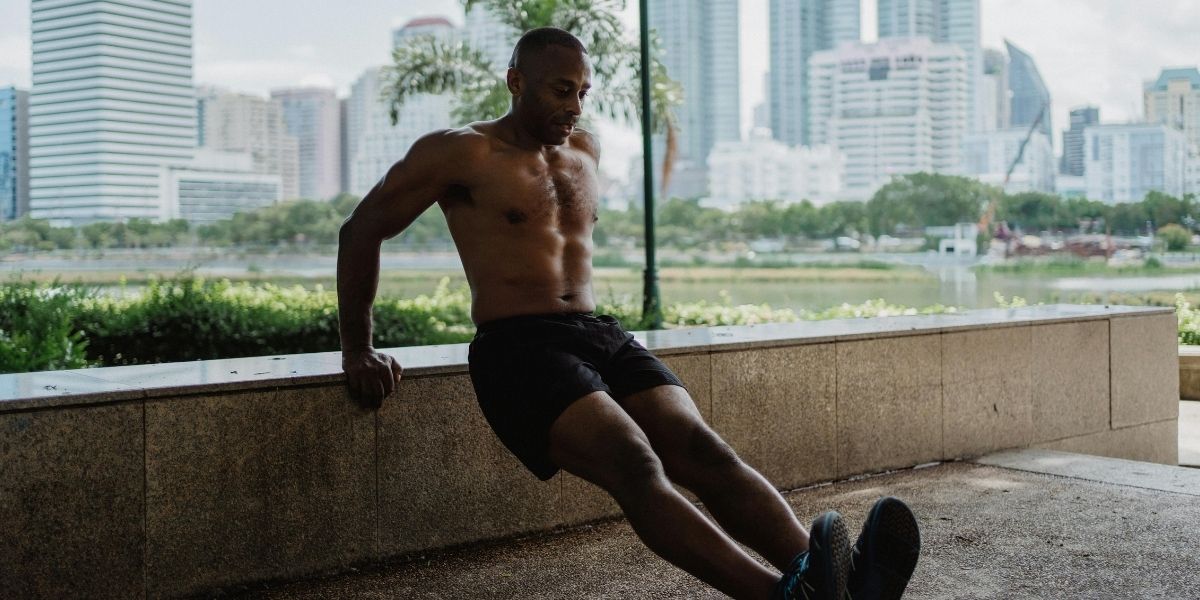
Since you cannot simply add weight to keep progressing, density, meaning more quality work in a fixed period of time, becomes your main lever. A 20 minute circuit of push-ups, squats, and a loaded carry variation, moving with minimal rest between rounds, builds real conditioning without a single piece of equipment beyond whatever you can carry. Tracking how many rounds you complete in that window, and trying to beat it over successive sessions, gives you a clear progression metric even without added weight.
Carries Bridge the Gap
If you have access to even one kettlebell or a heavy bag, kettlebell functional training built around carries adds a loading option that bodyweight movements alone cannot fully replicate, particularly for grip and midline stability. This is worth adding in even to an otherwise equipment free program if you have access to even a single implement.
Structuring a Full Session
A no equipment session works best built around a push pattern, a pull pattern, a squat or hinge pattern, and a core or carry finisher. Push-ups, inverted rows on a sturdy table or low bar, bodyweight squats or single leg work, and a plank or carry variation cover the full body without needing a single machine. Rotating which variation of each pattern you use week to week keeps the stimulus fresh even within a fixed set of movements.

Recovery Still Matters
Bodyweight training can accumulate real fatigue, especially once you add tempo and density work on top of standard rep schemes. Treat your post workout nutrition the same way you would after a heavy barbell session, since the muscle damage from a hard bodyweight circuit is not meaningfully different just because the resistance came from your own mass instead of a plate, and your body does not distinguish between the two sources of fatigue.
When You Want to Scale Up
No equipment workouts are a legitimate long term training method, not just a stopgap for when you cannot get to a gym. If you eventually want to test that base of strength and conditioning against a structured event, training for hyrox is a natural next step, since the hybrid demands of that format reward exactly the kind of full body conditioning a solid bodyweight program builds over months of consistent training.