Most guys chasing bigger numbers in their kettlebell workouts assume the fix is always more volume, heavier bells, or more grinding. They lift hard, eat their protein, then sit hunched over a desk or a steering wheel for the rest of the day and wonder why their swing or overhead press has stalled out.
Here is the part that gets missed. A kettlebell swing, snatch, or overhead press, three of the best kettlebell exercises for building real strength, all demand a real amount of hip and shoulder range of motion to execute correctly. If a joint is stiff and restricted, your body is not just less flexible, it is physically forced into a worse position to move the weight, which caps how much power you can actually produce.
Getting more out of your kettlebell workouts for men often has less to do with adding weight and more to do with fixing the two or three tight zones that are quietly limiting your best lifts.
How Stiff Joints Cap Your Kettlebell Numbers
This is mostly simple mechanics. When a joint cannot move through its full range, your body finds an alternate path, and that alternate path is almost always a weaker, less efficient position.
- Tight hips flatten your swing: The kettlebell swing depends on a strong hip hinge. If your hip flexors are chronically tight from sitting, you cannot fully open your hips at the top of the swing, which weakens your glute drive and shifts more strain onto your lower back.
- Stiff shoulders and upper back wreck your overhead lockout: Pressing or snatching a kettlebell overhead requires your shoulder and upper back to move freely. A restricted upper back forces you to arch your lower back to get the bell overhead, which is a weaker, riskier position than a stacked, upright lockout.
- Restricted ankles shorten your squat pattern: Goblet squats and cleans both rely on your ankle bending forward cleanly. Stiff ankles push your weight onto your toes and round your lower back, robbing you of leg drive.
It is worth noting there is real research on joints becoming neurologically inhibited after an actual injury, like a torn ACL, where the nervous system reflexively holds back muscle activation around the damaged joint (Refer to reference 1). Everyday stiffness from sitting is a different, much simpler mechanical problem, but the basic idea is the same: a compromised joint means a compromised lift.
Fixing the Three Biggest Restrictions
- For Tight Hips: Spend 2 minutes per side on a kneeling hip flexor stretch before your swings, actively squeezing your glute on the stretched side to help the hip flexor let go.
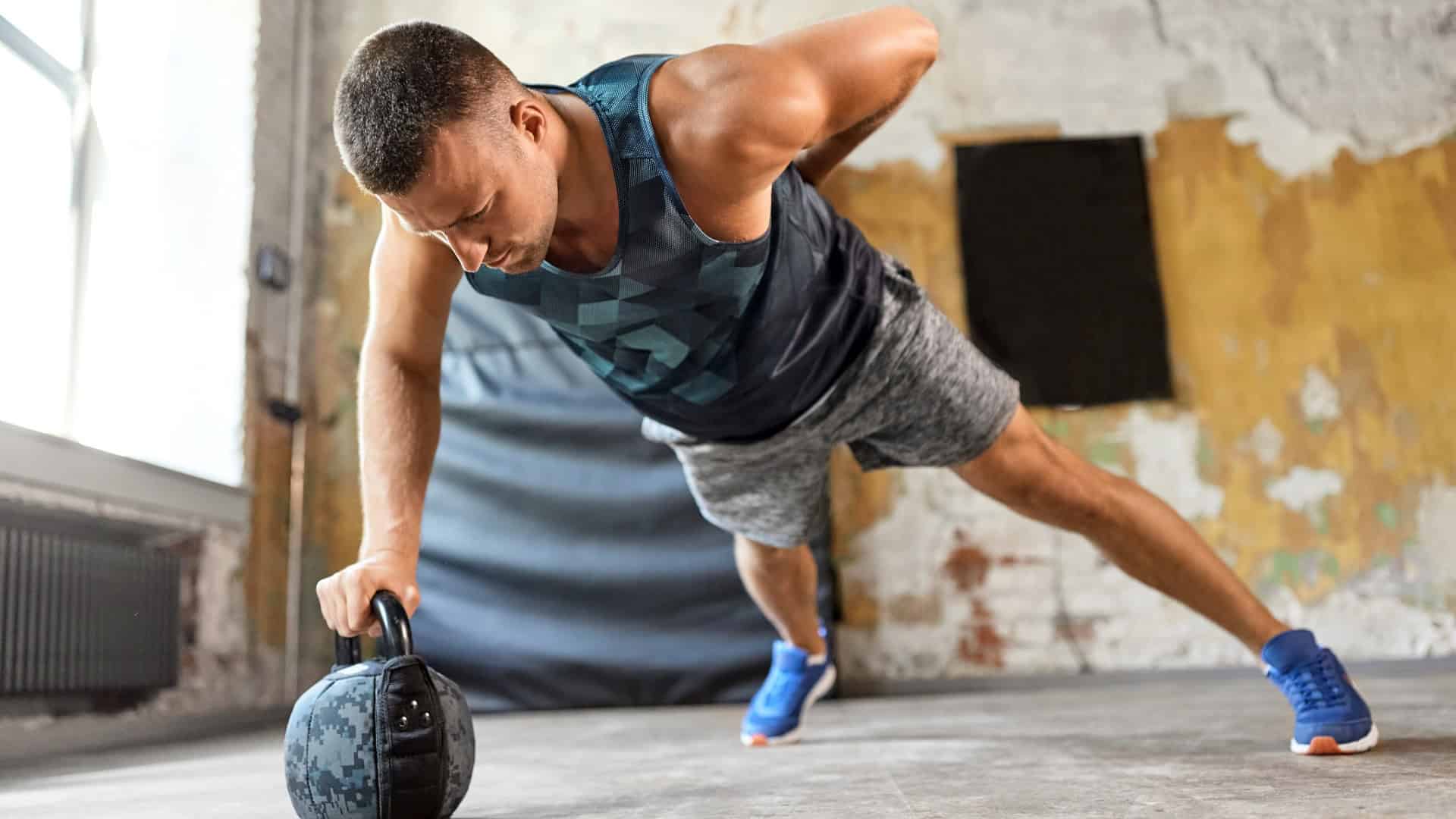
- For a Stiff Upper Back: Foam roll your thoracic spine for 1 to 2 minutes, then follow it with slow, controlled arm circles overhead to reinforce the new range of motion. If your overhead lockout still feels shaky once the range is there, the missing piece is often raw pressing control, which is exactly what a solid beginner push ups progression builds before you ever load a bell overhead.
- For Restricted Ankles: In a split stance, gently drive your front knee forward over your toes while keeping your heel flat, holding briefly at the end range for 8 reps per side.
Tracking Whether It Is Working
| Tracking Metric | Good Progress Sign | Warning Sign |
|---|---|---|
| Hip Hinge Depth | You feel a strong glute squeeze and full hip extension at the top of your swing. | Your lower back feels the strain more than your glutes at the top of the swing. |
| Overhead Lockout | The bell locks out overhead with your ribs down and your lower back neutral. | You have to arch your lower back hard to get the bell fully overhead. |
| Squat Position | Your heels stay flat and your torso stays fairly upright through the squat. | Your heels lift off the floor or your lower back rounds at the bottom. |
A Quick Note: Kettlebell swings and snatches are ballistic movements that put real load through your lower back and shoulders. If you are new to kettlebell training, consider learning the swing and snatch from a qualified coach first. If you have an existing back, hip, or shoulder injury, check with a doctor or physical therapist before adding these movements or mobility drills to your routine. On the heavier days, some lifters also lean on deliberate cold exposure to take the edge off, dialing in an ice bath temperature rather than just guessing at how cold is cold enough.
The High-Performance Takeaway: You are only as strong as your most restricted joint. Before you add more weight to your kettlebell workouts for men, spend a few minutes fixing your hips, upper back, and ankles, and watch your numbers move without adding a single pound to the bell.
References:
1. Arthrogenic Muscle Inhibition Manifests in Thigh Musculature Motor Unit Characteristics After Anterior Cruciate Ligament Injury, PMC: https://pmc.ncbi.nlm.nih.gov/articles/PMC9626399/