
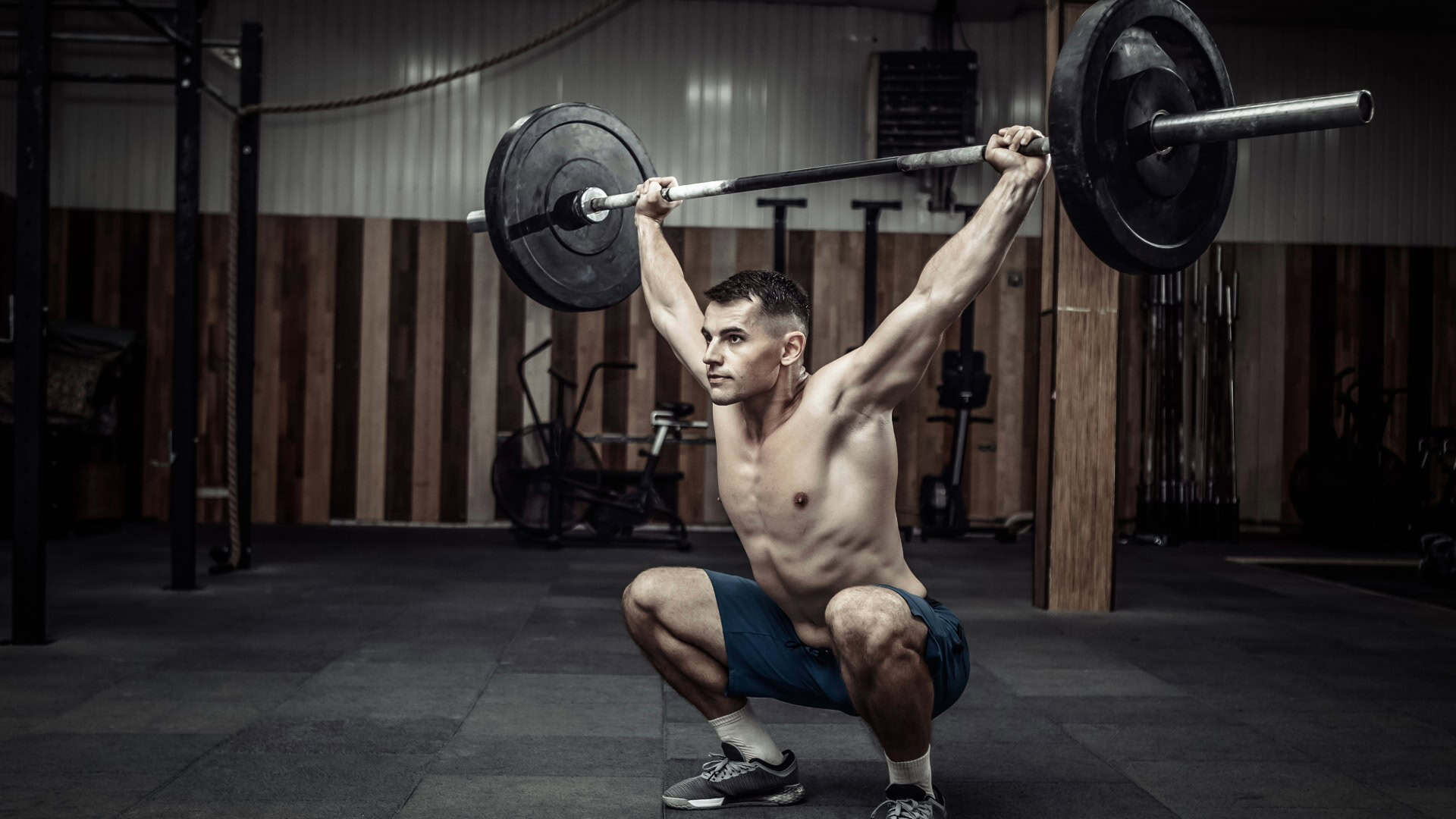
Most dedicated lifting enthusiasts treat poor upper-body positioning as a simple flexibility issue. When their arms struggle to stay locked out directly over their ears during an overhead squat or snatch, they immediately grab a light resistance band and perform endless, mindless shoulder dislocates. They assume that if they can just stretch out their tight pecs and anterior shoulders, their overhead geometry will naturally fix itself.
However, your shoulders do not operate in a vacuum. In the complex architecture of the upper kinetic chain, your scapulae and glenohumeral joints rely entirely on the positioning of the structural pillar underneath them: the thoracic spine. Chronic thoracic stiffness from hours of desk sitting locks your upper back into a flexed, slouched posture, and from that position your shoulder blades physically cannot tilt backward to allow your arms to reach overhead safely. Forcing the range of motion anyway does not fix your lift. It converts your rotator cuff into a localized friction zone. In my clinical assessments, roughly four out of five lifters presenting with "tight shoulders" test clean at the glenohumeral joint and fail at the thoracic segments underneath it.
To eliminate these overhead bottlenecks and maximize your lifting efficiency, you must address your movement mechanics from the spine outward. This comprehensive guide breaks down the exact biomechanical science of t spine mobility, showing you how to strengthen the thoracic spine into genuine extension, program targeted thoracic mobility exercises, and restore active scapular control so you can lift heavy, clean, and entirely pain-free, whether your week is built around a barbell or a bodyweight workout plan that leans on overhead presses and handstand work.
The Biomechanics of Overhead Restrictions
When your thoracic spine is immobile, your upper-body mechanics experience a cascade of structural failures whenever you press or hold a load overhead. The same restriction shows up for hybrid athletes splitting their week between heavy pressing and long mileage, where thoracic rotation still drives arm swing efficiency mile after mile, the same crowd often asking is creatine good for runners when they're dialing in fueling alongside the lifting. This movement compromise manifests across three specific pathways:
- The Lumbar Arch Compensation: If your upper back cannot extend to bring a barbell overhead, your nervous system forces you to arch your lower back aggressively to cheat an upright appearance. This hyper-lordotic tilt places crushing shear forces straight onto your lumbar discs.
- Scapular Winging and Rotator Impingement: A slouched thoracic spine physically blocks the upward rotation of your shoulder blades. As your arms try to force their way back, the soft tissues of your rotator cuff get trapped against the bone, causing sharp, chronic pinching.
- Forward Center of Mass Shift: Poor overhead tracking forces the barbell forward of your mid-foot. This slight mechanical variance instantly destroys your balance, forcing your quads, knees, and wrists to work under extreme, un-leveraged strain to save the lift.
The T Spine Mobility Protocol for Overhead Lifters
To release stuck thoracic segments, stabilize the shoulder capsules, and optimize your overhead mechanics, execute this targeted three-phase protocol before your heavy overhead pressing or Olympic lifting windows. Unlike passive thoracic spine stretches, every drill here demands active muscular control of the new range.
Phase 1: Segmental Thoracic Fulcrum Extension (10 Minutes)
This block targets individual bony segments of your upper back. We must manually separate the stuck spinal joints before attempting to train the surrounding muscle tissue.
- The Protocol: Foam Roller Thoracic Extension with Fulcrum Anchoring (3 sets of 5 slow melting wraps). Place a firm foam roller horizontally across your mid-back, right at the base of your rib cage. Interlock your fingers behind your neck to support your head, and pull your elbows tight together pointing toward the ceiling.
- The Execution: Keep your glutes pinned flat to the floor and squeeze your core tight to prevent your lower back from moving. Inhale deeply, and as you exhale, slowly melt your upper back backward over the roller. Hold for 3 seconds, roll up exactly one inch to the next spinal segment, and repeat. Do not roll back and forth rapidly; treat each spinal segment like a precise joint to unlock.
Phase 2: True End-Range Scapular Clearance (10 Minutes)
Once your thoracic spine is moving, you must immediately teach your shoulder blades to slide smoothly across your newly extended rib cage, prioritizing active serratus anterior and lower trap engagement.
- Prone Liftoffs from Wall Slides (3 sets of 8 reps): Sit flat against a wall, facing inward. Place your forearms flat against the wall in a narrow V. Slide your hands straight up the wall until your arms are fully extended. At the very top, actively squeeze your mid-back to lift your hands 1 inch away from the wall while keeping your nose pointed straight ahead. Hold for 2 seconds before lowering.
- The Bench-Supported Scapular Prone Swims (6 fluid loops): Lie face down on a bench or floor. Extend your arms forward into a Y position. Move your arms slowly in a massive circle out to a T, flip your palms up toward the ceiling, and trace them down to your lower back into a W shape. Keep your hands as high off the ground as humanly possible throughout the entire sweep.
Phase 3: Neurological Overhead Stability Integration (5 Minutes)
Cap the mobility loop by proving to your central nervous system that you can actively control your newly earned joint space under real structural load. This is how to strengthen thoracic spine extension so it holds under a barbell instead of collapsing at rep three.
- The Half-Kneeling Kettlebell Bottoms-Up Press (3 sets of 6 reps per side): Drop into a half-kneeling position on the floor. Hold a light kettlebell upside down by the handle, keeping the heavy base balanced vertically in the air. Squeeze your core and press the bell straight up overhead until your bicep aligns directly with your ear.
- The Focus: The unstable bottoms-up weight forces your deep rotator cuff, obliques, and serratus muscles to fire at a near-maximal rate to stabilize the load. This cements your new range of motion as a recognized safe zone for future heavy barbell work. Lifters nursing extra rotator cuff irritation while this range develops often pair the session with deliberate cold exposure afterward, dialing in their ice bath temperature rather than just guessing at how cold is cold enough.
Tracking Upper Body Mechanics & Posture Changes
Achieving true structural balance in your upper torso requires checking your range of motion against objective physical markers. Monitor these simple performance variables weekly to ensure your kinetic alignment is progressing safely:
| Overhead Mobility Metric | Optimal Performance Sign | Upper Kinetic Breakdown Flag |
|---|---|---|
| The Flat-Back Wall Test | Standing flat against a wall with your heels, glutes, upper back, and hands touching simultaneously without your ribs flaring out. | Your lower back arches away from the wall, or your wrists hover 3+ inches away from the surface due to persistent thoracic stiffness. |
| Barbell Overhead Alignment | The barbell aligns directly over your heel bones at the bottom of an overhead squat, with elbows locked bone-on-bone. | The barbell drifts forward toward your toes, causing your torso to incline aggressively to avoid dropping the weight. |
| Scapular Gliding Contour | Shoulder blades slide smoothly across your back during pressing movements without making grinding noises or clicking. | A distinct popping sound inside the joint capsule, accompanied by one shoulder blade winging outward aggressively. |
The Longevity Takeaway: True overhead power is completely dependent on your underlying physical geometry, not your pain tolerance. By replacing lazy static shoulder stretches with a precise framework of thoracic spine mobility work and active scapular mobilization, you instantly clear the biomechanical bottlenecks capping your lifts. Protect your joint capsules, rule your movement alignment, and build a powerful upper body engineered to perform without limitations.